
When measuring for thick quartz countertops, you’ll need to evaluate three standard thickness options: 2cm (¾”), 3cm (1¼”), and 4cm (1½”). Each thickness requires specific support intervals: 24″ for 2cm, 36″ for 3cm, and 42″ for 4cm. Calculate your total square footage by multiplying length by width in inches, then dividing by 144. Don’t forget to account for edge profiles and overhangs in your measurements. This guide investigates the full scope of technical specifications you’ll need.
Standard Thickness Options for Quartz Countertops
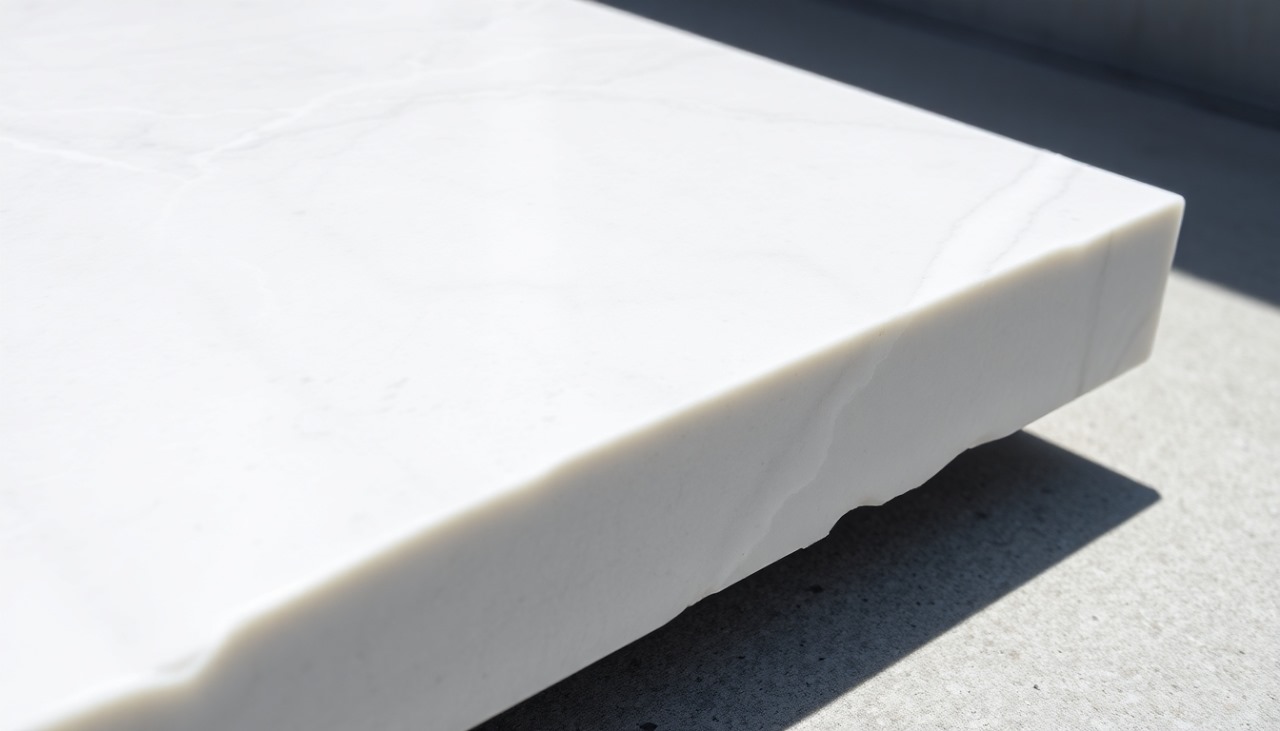
Three standard thicknesses dominate the quartz countertop market: 2cm (¾ inch), 3cm (1¼ inch), and 4cm (1½ inch). Each thickness offers distinct design trends and durability factors you’ll need to take into account for your project.
The 2cm thickness serves as an economical choice that’s ideal for vertical applications and smaller spaces. You’ll find 3cm as the most popular option, providing peak structural integrity while maintaining a sleek profile that doesn’t overwhelm your space. For dramatic impact, 4cm thickness creates a bold, luxurious appearance that’s particularly striking on kitchen islands and statement pieces.
When selecting thickness, you’ll need to factor in your cabinet support structure. While 2cm often requires supplementary substrate reinforcement, 3cm and 4cm variations can typically span longer distances without extra support.
Weight Considerations and Structural Support
Quartz countertop weight varies considerably based on thickness, with each centimeter contributing approximately 10 pounds per square foot to your installation load. For a 2cm thick quartz slab, you’ll need to account for roughly 20 pounds per square foot, while a 3cm piece weighs about 30 pounds per square foot.
To maintain structural integrity, you’ll need proper support every 24 inches along the cabinet base. Install a solid wood perimeter frame and incorporate perpendicular support bars for ideal weight distribution. For countertops with overhangs exceeding 12 inches, you must use corbels or steel brackets every 24 inches. If you’re installing an undermount sink or cooktop, supplementary support bracing around these cutouts is crucial to prevent stress cracks and guarantee long-term stability.
Edge Profile Possibilities for Thick Quartz
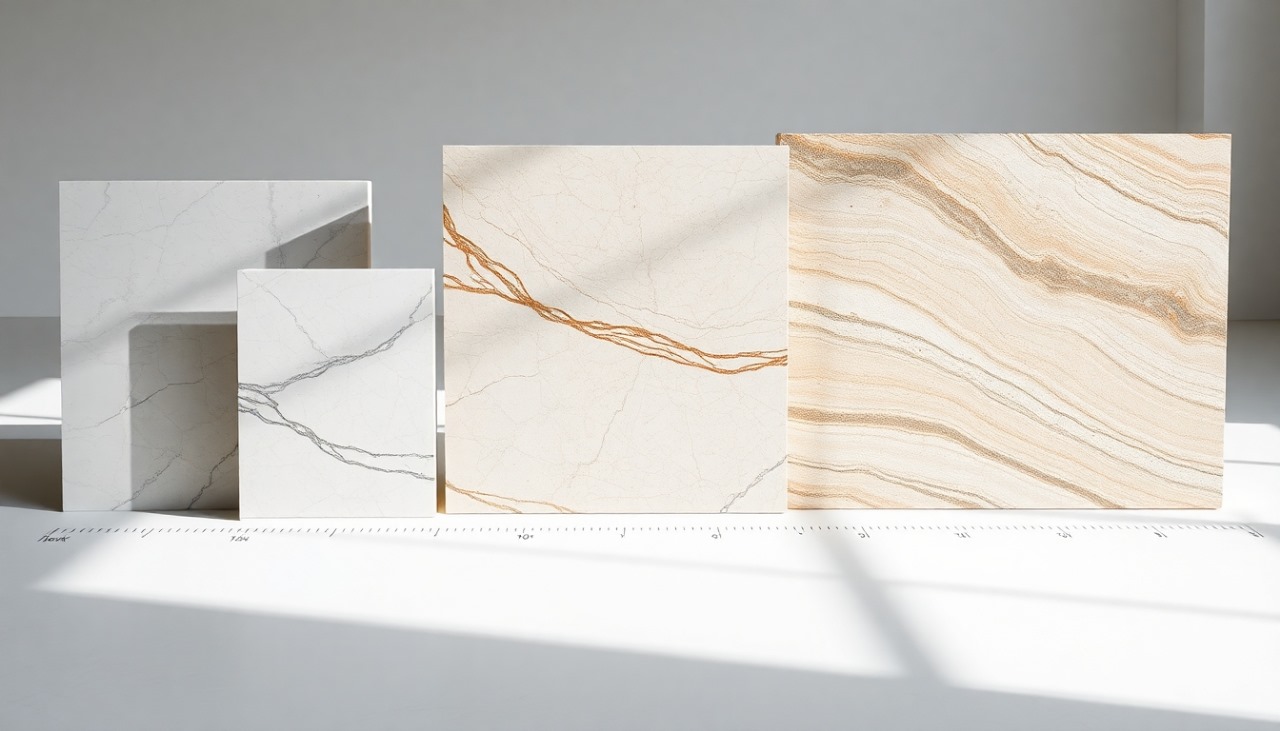
When selecting edge profiles for thick quartz installations, you’ll find numerous design options that complement the slab’s substantial depth. Your 3cm or 6cm quartz countertop can feature classic treatments like the square edge for modern appeal or the softened bullnose edge for traditional spaces. The mitered edge creates dramatic 2″-3″ thick profiles, while the waterfall edge extends vertically to the floor.
- Traditional profiles: Standard bullnose provides a smooth, rounded finish at 3cm, while the ogee edge offers an elegant S-curve design requiring 6cm thickness
- Contemporary options: Chamfered edge creates 45-degree angles, and bevel edge provides subtle angular detail
- Custom treatments: Specialized fabrication allows for hybrid edges combining multiple profiles, like stepped bevel or double-ogee designs
Cost Factors Based on Thickness Selection
When selecting quartz countertop thickness, you’ll need to factor in significant cost differentials between 2cm and 3cm slabs, with thicker materials typically commanding a 20-30% premium. Your installation costs will increase with thicker slabs due to extra labor requirements for handling and supporting the heavier material, especially for spans exceeding 24 inches. The complexity of your chosen edge profile directly impacts fabrication costs, with waterfall edges and mitered treatments requiring more skilled labor and precision cutting than standard eased or bullnose profiles on thick quartz installations.
Labor and Installation Rates
Installation costs for thick quartz countertops vary considerably based on their thickness specifications, with 3cm (1.25″) slabs typically commanding 15-25% higher labor rates than standard 2cm (0.75″) options. You’ll find that labor costs increase due to the extra weight and specialized installation techniques required for thicker materials.
- Base installation rates range from $40-75 per square foot for 2cm quartz, while 3cm installations typically cost $55-95 per square foot
- Complex edge profiles and seam work on thick quartz require specialized diamond tooling, adding $10-15 per linear foot
- Support structure modifications often become necessary for 3cm installations, requiring reinforced cabinet bracing at $3-5 per linear foot
When calculating your project budget, factor in these thickness-dependent installation variables to avoid unexpected cost increases during the installation phase.
Material Thickness Price Differences
The cost differential between 2cm and 3cm quartz countertop slabs primarily stems from raw material volume and manufacturing complexity. When comparing thickness benefits, you’ll find that 3cm slabs typically cost 20-30% more than their 2cm counterparts due to increased material usage and specialized fabrication requirements.
| Thickness | Price/sq ft | Edge Options | Structural Support | Installation Complexity |
|---|---|---|---|---|
| 2cm | $65-85 | Limited | More needed | Standard |
| 2.5cm | $75-95 | Standard | Moderate | Moderate |
| 3cm | $85-115 | Extended | Minimal | Complex |
| 4cm | $120-150 | Premium | None | Advanced |
| 6cm | $180-250 | Custom | None | Specialized |
Your price comparison should factor in that thicker slabs reduce support requirements and offer improved edge profile options, potentially offsetting their higher initial cost through reduced auxiliary material needs.
Edge Treatment Cost Variations
Selecting edge profiles for quartz countertops directly impacts your fabrication costs, with pricing variations tied to material thickness and complexity. You’ll find that thicker materials require more specialized edge treatment materials and extensive fabrication time, particularly for ornate designs.
- Standard edge treatment styles like straight, eased, or bullnose typically cost $10-15 per linear foot for 2cm quartz, while these same profiles on 3cm material range from $15-20 per linear foot.
- Premium edges such as ogee or waterfall designs increase costs by 40-60% due to extra fabrication time and specialized tooling requirements.
- Multi-layer edge treatments combining 2cm or 3cm pieces can double your costs, reaching $35-45 per linear foot, but create dramatic architectural features.
Consider your budget constraints when selecting edge profiles, as intricate designs greatly impact final pricing.
Installation Requirements for Different Thicknesses
When planning your thick quartz countertop project, proper installation requirements vary considerably between 2cm (¾”), 3cm (1¼”), and custom thicknesses. You’ll need to account for specific installation techniques and thickness benefits that impact support requirements.
| Thickness | Support Spacing | Load Capacity | Edge Support | Overhang Max |
|---|---|---|---|---|
| 2cm (¾”) | 24″ centers | 400 lbs/sqft | Every 12″ | 8 inches |
| 3cm (1¼”) | 36″ centers | 600 lbs/sqft | Every 18″ | 12 inches |
| 4cm (1½”) | 42″ centers | 800 lbs/sqft | Every 24″ | 15 inches |
| 5cm (2″) | 48″ centers | 1000 lbs/sqft | Every 30″ | 18 inches |
| 6cm (2½”) | 54″ centers | 1200 lbs/sqft | Every 36″ | 24 inches |
Thicker slabs require fewer support brackets but demand stronger cabinet structures. You’ll need specialized mounting hardware rated for your chosen thickness.
Aesthetic Impact of Thicker Quartz Slabs
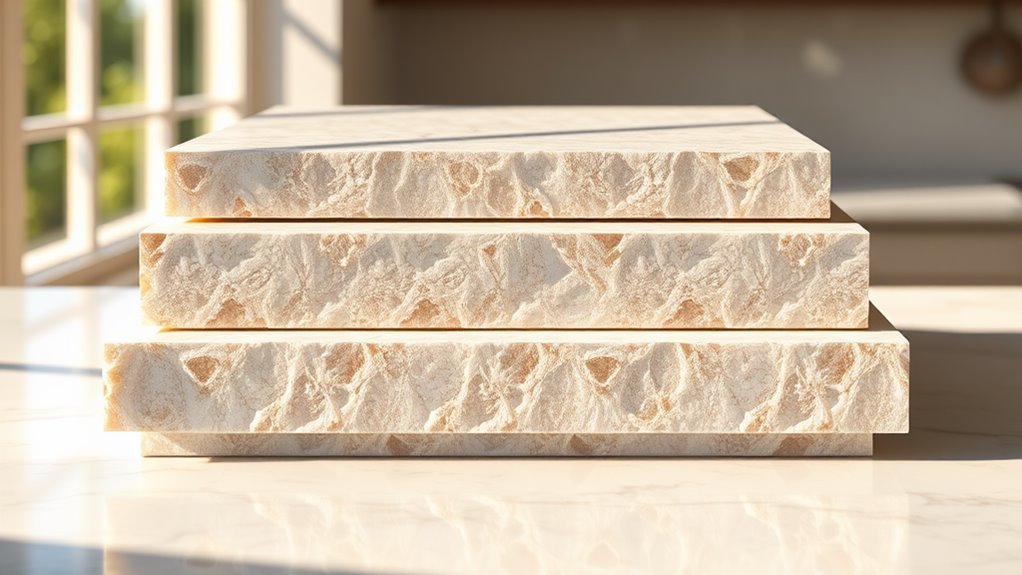
Beyond structural considerations, thicker quartz slabs dramatically influence your countertop’s visual presence and design versatility. The improved thickness creates substantial visual weight, establishing your countertop as a focal point within your kitchen or bathroom space. Thicker profiles, particularly in 3cm (1.25″) and 4cm (1.57″) measurements, deliver superior aesthetic appeal through their sturdy appearance.
- 3cm edges create pronounced shadow lines and crisp shifts between surfaces, improving architectural definition
- 4cm thickness allows for specialized edge profiles like waterfall cascades and mitered corners without lamination
- Thicker slabs enable deeper engravings and detailed edge treatments up to 6cm (2.36″) when doubled
The increased mass of thick quartz transforms ordinary countertops into statement pieces, especially when paired with modern minimalist cabinetry or industrial design elements.
Measuring and Calculating Quartz Dimensions
Measuring your quartz countertop requires precise linear measurements using a laser measure or steel tape along cabinet edges, with special attention to cutouts for sinks and appliances following industry-standard inside corner calculations. You’ll need to calculate total square footage by multiplying length by width (in inches) and dividing by 144, accounting for any overhangs or waterfall edges in your final dimensions. Your edge profile selection, whether standard eased, bullnose, or specialty options like ogee or dupont, will impact both the final measurements and material requirements, particularly for thicker 3cm slabs.
Standard Measuring Best Practices
To guarantee precise quartz countertop fabrication, accurate measurements and calculations serve as the foundation for every successful installation. You’ll need professional-grade measuring tools, including a laser measure, steel tape measure, and digital calipers for the most accurate results. Always document your measurement conversions from imperial to metric to avoid costly mistakes during fabrication.
- Take measurements at multiple points along the countertop length and width, accounting for any variations in wall straightness
- Record all dimensions in both decimal inches and millimeters, maintaining consistency throughout your documentation
- Double-check your calculations using a digital measurement app to verify your manual measurements, especially for complex layouts with angles or curves
Remember to measure for overhang requirements and backsplash heights while considering existing cabinet dimensions and wall specifications.
Calculating Square Footage Costs
Accurate quartz countertop cost calculations depend on precise square footage measurements of your surface area. To determine total square footage, multiply the length by width in inches, then divide by 144 to convert to square feet. You’ll need to factor in any cutouts for sinks or appliances, which typically don’t reduce the entire cost considerably.
For a detailed cost breakdown, multiply your total square footage by the material price per square foot. Most thick quartz countertops range from $50-$200 per square foot, including installation. Your square footage estimation should also account for overhangs, backsplashes, and edge treatments. Don’t forget to include 10-15% extra material for seams, cuts, and potential waste. Complex layouts with multiple angles or curves may require further material calculations.
Complex Edge Profile Options
When selecting edge profiles for thick quartz countertops, you’ll need to factor their dimensions into your thorough measurements. A classic bevel edge requires a 45-degree angle calculation, while a waterfalled edge demands precise vertical dimensions for seamless alignment. Complex edge profiles can greatly impact your material requirements and final costs.
- Standard bevel edges extend 1/4 inch to 1/2 inch from the countertop face, requiring extra material width in your calculations.
- Waterfalled edges need exact height measurements from counter surface to floor, plus 1 inch overhang allowance.
- Double-thickness edge profiles require 2 3/4 inches of material depth, accounting for the primary 1 1/2-inch thickness plus supporting substrate.
These specialized edge treatments affect both aesthetic appeal and structural integrity, so you’ll want to incorporate their measurements into your initial planning phase.
Frequently Asked Questions
Can Thick Quartz Countertops Be Cut or Modified After Installation?
While you can modify installed thick quartz countertops, it’s best to have professional fabricators handle any cutting techniques or modification options. They’ll use specialized diamond-tipped tools and wet-cutting methods to prevent chips or cracks. You’ll need to take into account that on-site modifications create dust and require proper ventilation. Common alterations include adjusting edges, creating new holes for fixtures, or modifying seams, but extensive changes aren’t recommended post-installation.
How Long Does Thick Quartz Take to Cure After Installation?
You don’t need to wait for quartz to cure after installation since it’s engineered stone that’s already fully cured during manufacturing. However, the adhesives and sealants used in the installation process do require curing time. You’ll need to allow 24-48 hours for silicone adhesives to fully cure, and epoxy seams typically need 12-24 hours. Don’t apply heavy pressure or place objects on newly installed seams during this cure time.
Does Thicker Quartz Provide Better Resistance Against Heat and Scratches?
The thickness of quartz doesn’t considerably affect its heat resistance or scratch durability. You’ll find that a 2cm quartz slab offers the same surface protection as a 3cm piece since these properties are inherent to the material’s composition – typically 90-95% ground quartz mixed with polymer resins. For heat resistance up to 150°F (65.5°C) and scratch resistance of 7 on Mohs scale, you’ll get identical performance regardless of thickness.
Can Existing Cabinets Support an Upgrade From Thin to Thick Quartz?
You’ll need a professional assessment of your cabinet structure before upgrading to thicker quartz. Standard cabinets are typically designed to support 18-20 pounds per square foot, while 3cm quartz can weigh 25-30 pounds per square foot. Your installation requirements may include reinforcing cabinet frames, adding support brackets, or modifying corner bracing. It’s essential to verify your cabinet’s load-bearing capacity and guarantee it meets manufacturer specifications for thick quartz installations.
Will Thick Quartz Countertops Affect the Resale Value of My Home?
Installing thick quartz countertops will typically boost your home’s resale value and market appeal. You’ll see a 75-80% return on investment, as premium 3cm quartz surfaces are highly sought after by homebuyers. The improved durability and luxurious aesthetic of thick quartz adds perceived value to your kitchen space. Real estate data shows that homes with high-end quartz countertops often sell faster and command higher prices than those with standard countertop materials.